

Powering A New Era of Confidential AI With Confidential Computing
February 15, 2026
Scalar Tape Storage
February 15, 2026Why Certification Has Become a Strategic Control for CISOs

Executive Summary
Certifications have moved from background compliance artifacts to a practical control CISOs use to demonstrate how security is designed, governed, and sustained. As regulatory requirements expand and fragment, boards increasingly demand evidence over assurance, while customers and partners expect claims that can be independently verified.
Certification provides a common reference point that aligns development discipline, operational execution, and executive accountability. When treated as an integrated part of security architecture rather than a series of checklists, certification becomes a way to scale trust, manage complexity, and communicate risk clearly across technical, regulatory, and leadership audiences.
As a CISO, it is important to select partners who understand certification and can support your organization in its journey from helping you achieve compliance through robust security controls and monitoring to certifying its own products so they can be deployed in a compliant manner.
Certification Is No Longer a Background Activity
For many years, certifications largely existed in the background of cybersecurity programs. They were required for audits and procurement, but they rarely shaped how CISOs explained risk, maturity, or operational readiness to executive leadership.
As the scope of the CISO role has expanded, however, that separation has become harder to sustain. Certification is now one of the more effective ways to show how security is built into products, governed across teams, and applied consistently over time. It creates a shared reference point that technical staff, executives, regulators, and customers can all evaluate without translation.
This shift is not about messaging or positioning. It reflects a change in how security accountability is assessed and enforced.
The Environment CISOs Are Navigating
Most CISOs are operating under rising regulatory pressure combined with increasing regional divergence. Frameworks such as NIS2, the EU Cyber Resilience Act, and a growing set of national and sector-specific requirements such as DORA are raising expectations and driving best-practice.
Boards are responding accordingly. They want evidence that security is engineered into how technology is developed and maintained, not reassurance that controls exist in principle. Customers and partners are also more selective, increasingly expecting assurance they can verify independently rather than accepting claims at face value.
What Certification Actually Demonstrates
From a CISO’s perspective, the value of certification is not the badge. It is what the certification obliges an organization to define, document, and most importantly, sustain.
A credible certification program demonstrates that security requirements are enforced across the organization rather than dependent on individual judgment. It shows that vulnerability handling, update processes, and life-cycle management follow defined governance. It also provides external confirmation that these practices are reviewed against a recognized standard.
This matters because it shifts conversations from intent to execution. It allows CISOs to demonstrate how security is practiced day to day, not just how it is described. That distinction becomes especially important under scrutiny, including after incidents, when organizations are expected to explain not only what happened but also how their security processes were designed to manage and limit risk.
How Fortinet Demonstrates Leadership in Certification
The fragmentation of certification standards across regions and industries is something every CISO has to navigate. Different markets impose different requirements, often with overlapping intent but different structures. While that adds complexity, the purpose of certification remains the same: to provide independent proof that security is built into how products are designed, developed, and maintained.
Fortinet treats certification as a core part of how the company operates, driving excellence in our development processes, vulnerability handling, and lifecycle management as well as the resilience of our business.
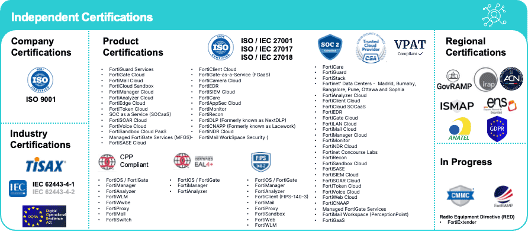
Today, we maintain more than 130 active certifications across the organization, our products, and our development and governance processes. That scale matters because it shows a consistent, repeatable approach to security rather than one-off efforts for specific markets or deals.
The latest achievement in this ever-growing list is IEC 62443-4-1 certification at Maturity Level 2 (ML2) for the Secure Product Development Lifecycle (SPDL), a globally recognized benchmark for secure engineering practices in industrial automation and control systems (IACS) product development.
This achievement reflects Fortinet’s ongoing commitment to designing and delivering cybersecurity products with security built in from the start, reinforcing trust for customers across operational technology (OT), critical infrastructure, information technology (IT), and converged IT/OT environments.
In practice, this means secure development requirements aligned to certification standards are treated as part of normal engineering activity. Teams address them during design, code review, testing, and release processes instead of as audit-driven tasks. Core practices such as threat modeling, vulnerability remediation timelines, dependency management, and change control are defined once and applied consistently across products.
Why This Matters
CISOs are increasingly expected to explain not only security outcomes, but the systems, controls, and decisions that produced them. Certification gives organizations a structured way to demonstrate how security is designed, governed, and sustained as they scale. It also strengthens credibility under regulatory, customer, and post-incident scrutiny, when claims are examined most closely.
In regulated and operationally complex environments, this is no longer optional. It is now part of how the CISO role is exercised and evaluated.
Choosing Fortinet as a trusted partner can give the peace of mind that the products you are deploying into your critical networks and the processes used to design and build them have been independently verified to the highest standards.
Transparency and Verifiable Assurance
Certification only builds trust if it can be examined. Making certification scope, assessment context, and supporting documentation accessible allows stakeholders to verify claims independently rather than relying on summaries.
At Fortinet, this information is available through the Fortinet Trust Portal, our centralized resource for certifications, assessments, and security governance practices. Transparency of this kind is increasingly essential as trust becomes something that must be demonstrated, not asserted.