

What’s New in Veeam Data Platform v13.1 : Practitioner Takeaways from VeeamON 2026
May 24, 2026
Introducing PowerStore Elite: Built to Lead in an Unpredictable World
May 24, 2026The Future of Connectivity

Introducing the FortiExtender WAN 50G for the AI-Enabled Edge
As organizations expand distributed operations and adopt data-intensive AI applications, the demand for resilient, high-speed connectivity continues to increase. At the same time, the edge is becoming more complex, and traditional wired WAN connections are being supplemented—and in some cases replaced—by 5G.
Today, Fortinet introduces the FortiExtender WAN 50G (FEW-50G), an ultra-fast 5G gateway purpose-built to extend WAN connectivity for the FortiGate Next-Generation Firewall (NGFW), enabling secure, high-performance connectivity at the distributed edge.
High-Throughput Wireless WAN for the AI Era
The modern edge is no longer just about basic internet access; it’s about low-latency processing and massive data transfers. The FEW-50G addresses these demands head-on. By leveraging 5G technology, it provides a powerful wireless link that rivals or exceeds traditional fiber connections in both flexibility and deployment speed.
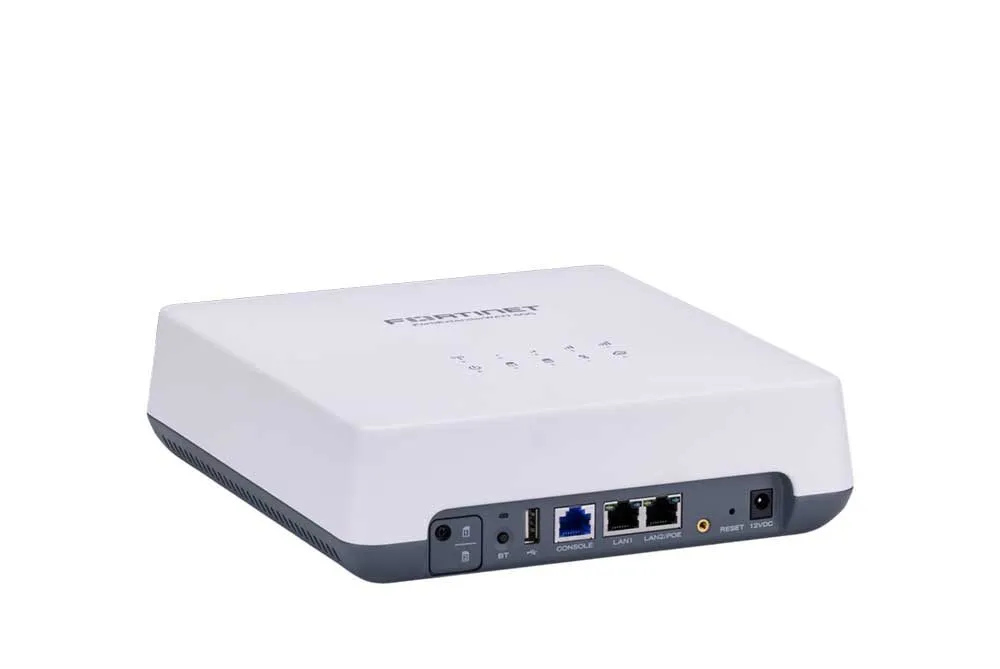
To ensure this massive wireless bandwidth isn't bottlenecked at the wire, the FEW-50G features two 5GE (5 Gigabit Ethernet) ports. These interfaces provide the high-throughput, low-latency connectivity required for real-time analytics and automated branch operations.
Designed for Discreet, High-Performance Deployment
A common challenge with high-performance 5G gateways is their physical footprint. Often, achieving optimal signal reception requires bulky external antennas that are difficult to mount in space-constrained environments such as retail kiosks, pop-up clinics, or ruggedized enclosures.
The FEW-50G addresses this with eight internal omnidirectional antennas, enabling:
- Optimal signal reception: Multi-angle coverage ensures a stable connection without the need for manual antenna alignment.
- Discreet form factor: Its sleek, compact design allows it to be placed in professional environments without disrupting the environment.
- Rugged versatility: The internal design makes it easier to fit into protective enclosures for harsh environments, reducing the risk of damage to or tampering with sensitive components.
Seamless Integration with FortiGate
While many devices in the FortiExtender portfolio offer LAN extension capabilities, the FEW-50G was engineered for a specific mission: empowering the FortiGate-driven edge. Rather than serving as a standalone router for local devices, the FEW-50G is designed to function as a dedicated WAN extension for the FortiGate NGFW. When deployed together, they form a seamless extension of the Fortinet Security Fabric, providing a robust WAN path managed directly through the FortiOS operating system interface.
Enhancing Resilience with Out-of-Band Management
Connectivity issues are most painful when you lose the ability to manage your equipment. The FEW-50G supports Out-of-Band (OOB) management via its dedicated console and USB ports. If the primary link fails, administrators can still access the FortiGate over the 5G tunnel for remote troubleshooting and configuration, avoiding costly on-site intervention.
Edge Reliability via VRRP
Business continuity is a non-negotiable requirement in the Fortinet Security Fabric. The FEW-50G supports the Virtual Router Redundancy Protocol (VRRP), enabling it to maintain connectivity in failure scenarios. In the event of a FortiGate hardware failure, the FortiExtender can assume the role of edge NAT router, preserving WAN access for downstream systems.
While the FEW-50G does not host FortiGuard security services—which remain centralized on the FortiGate—it does provide essential access control list (ACL) capabilities during failover. This ensures that traffic continues to be governed by basic security policies until the primary firewall is restored.
AI-Driven Operations: Powering the Self-Healing Edge
In an environment where uptime is critical, manually monitoring 5G signal quality and link health is no longer practical. The FEW-50G addresses this within the Fortinet ecosystem by continuously feeding rich telemetry into the machine-learning (ML) engine of FortiAIOps, providing real-time visibility into the health of 5G and LTE links.
By analyzing metrics such as latency, jitter, and signal-to-noise ratio, the system establishes adaptive performance baselines to detect anomalies before they can affect user experience. This integration enables automated troubleshooting, allowing the system to pinpoint the root cause of throughput degradation or link instability and recommend or initiate remediation. This approach helps keep the wireless WAN optimized, shifting operations from reactive troubleshooting to a more proactive, self-healing model.
Global Scalability: A Bird’s-Eye View from the Cloud
For enterprises managing hundreds or even thousands of branch locations, consistency and visibility are paramount. The FEW-50G can be seamlessly managed through Fortinet’s cloud management platforms, providing centralized visibility across global deployments.
With zero-touch provisioning (ZTP), devices can be shipped directly to remote sites and brought online instantly, without requiring an on-site engineer. From a single centralized dashboard, administrators can group devices by region, push global configuration updates, and monitor carrier data usage across the entire fleet. This cloud-native approach simplifies large-scale operations and ensures consistent configuration and monitoring across distributed environments.
Conclusion: A New Standard for the Distributed Enterprise
The FortiExtender WAN 50G is a core component of a modern WAN strategy. It combines 5Gbps wired throughput with an internal eight-antenna design to support the high-performance, resilient connectivity required for distributed environments and AI-driven workloads, as well as the reliability demanded by mission-critical branch offices.
By integrating the FEW-50G into your Fortinet Security Fabric, you aren't just adding a backup link—you are future-proofing your network edge with reliable, ultra-fast 5G connectivity that is centrally managed and operationally consistent.
Ready to upgrade your WAN? Contact your Fortinet representative today to learn more about the FortiExtender 50G and how it integrates with your existing FortiGate deployment.